Letter
Heel to Brow
The back of you is one continuous sheet of tissue. The front of you is not — plus the ninety-second foot release at the far end of that line.
Sōmavel5 min read

A curated briefing at the intersection of recovery science, material intelligence, and the quiet systems that govern how your body actually works.
Heel to Brow
The claim sounds like a stretch: the tissue under your foot is continuous with the tissue at your eyebrow. One sheet — up the back of the leg, up the spine, over the skull.
In 2016, a team at Goethe University checked. They screened 6,589 dissection studies, kept the 62 that actually tested whether one structure continues into the next, and graded every junction.
The line up the back held. Plantar fascia into the calf, calf into the hamstrings, hamstrings into the erectors along the spine — every transition verified, across fourteen independent studies. Not a metaphor. A sheet.
Zero: verified junctions in the mirror-image line up the front of the body, across seven studies. The quadriceps do not continue into the abdominals.
So the body is not symmetrically continuous. Whatever you were taught about everything being connected is narrower than that — and more interesting.
The Two-Step Release: The Foot
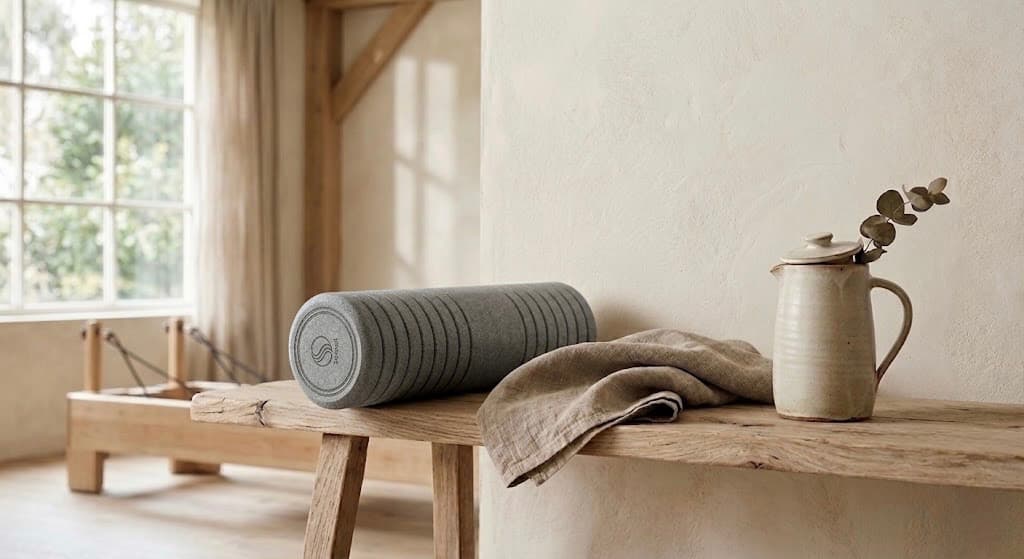
Calves in the first letter. The mid-back in the second. This one sits at the far end of the same line. Sit down, bare feet, Sōmagroove under one foot, ball of the foot on the barrel.
One foot only — the field test below needs the other untouched.
Step 1 — Pressure: Roll ball-to-heel at 1 inch/sec, two or three passes. Find the point that registers. Hold 30 seconds — let the leg’s weight settle in.
Step 2 — Movement: Holding that point, spread the toes wide, then curl them under. 5–8 times, slowly. The load stays still; the tissue moves under it.
You are not treating the foot. You are treating the line the foot happens to be at the end of.
If you have acute heel pain, a recent plantar fascia injury, or reduced sensation in your feet, speak with your clinician before loading the sole.
The Distance Paradox
Structure is settled. Function is messier. Rolling the sole does change what the hamstring can do — but not for everyone, and not by much.
Across plantar self-release trials from 2015 to 2023: a 2.5 cm sit-and-reach gain, roughly 1 in 5 participants improved, and the effect still measurable at 60 minutes.
Takeaway: If you are already open, ninety seconds on the sole may give you very little. If you are stiff, it is the highest-return ninety seconds in your practice.
The One-Foot Test
You have already set this up, if you did only one side. The asymmetry is the point.
Try this now: Stand with your feet together and fold forward. Don’t force it — let your hands hang and notice where they land. Then notice the difference between the two sides. Most people feel it immediately: one hamstring gives, one doesn’t.
This proves nothing on its own. Some of it is tissue, some is nervous system, and some is that you gave ninety seconds of attention to one foot and none to the other. Then do the second foot.
The Material That Doesn’t Spread
Press on almost any solid and it bulges sideways. Engineers put a number on it — Poisson’s ratio. Steel sits around 0.3. Rubber approaches 0.5.
Cork’s is approximately zero.
Compress it and it does not push outward. It takes the load in the direction you gave it and holds its shape. The pressure stays where you place it instead of spreading into the tissue around it. A groove under bodyweight stays a groove.
Foam does the opposite. It spreads. On a calf that difference is subtle. On the small, curved, densely-innervated underside of a foot, it is the whole thing.
Written by

Sōmavel
Practitioners, movement specialists, and material researchers writing on the practice of recovery, and the materials and rituals that make it last.